

Tell us about your campus website
A senior engineer reads every message and replies within one working day.
Why higher-ed web design is a category of its own
A university website is not a marketing site. It is a federated system that has to serve prospective students, current students, faculty, staff, alumni, donors, media, and researchers — each with different questions, different reading levels, and different points in a multi-year decision cycle.
College websites help prospective students compare programs and application requirements. Review research with your own audiences rather than relying on an unverified sector-wide percentage. The gap isn't design taste. It's the reality of shipping into an institution with 40+ departments, legacy Drupal or SharePoint stacks, accessibility mandates, and a governance model where nobody owns the whole page.
This is a starting list for procurement questions, not an independently verified ranking. Confirm each vendor’s current services, references, staffing, and prices directly before selection. Check current vendor information before procurement; this page is not an independently scored ranking.
The shortlist at a glance
Provider — evidence to request — scope to verify — pricing.
- DoodleWeb — review the published George Brown College and Young Americans Center case studies; confirm accessibility, content, migration, and support responsibilities; request an itemized quote.
- Kanopi Studios — request current higher-education references, platform demonstrations, and support terms; confirm scope directly; request a quote.
- OHO Interactive — request audience research examples and a relevant campus reference; confirm scope directly; request a quote.
- Orbit Media — request relevant website and measurement examples; confirm higher-education fit directly; request a quote.
- WebFX — request campus references and separation of website and marketing deliverables; confirm scope directly; request a quote.
- ERI Design — request application and integration examples relevant to your campus; confirm responsibilities directly; request a quote.
- Oomph — request accessibility testing and governance evidence; confirm scope directly; request a quote.
- Eastern Standard — request comparable migration and research examples; confirm scope directly; request a quote.
- Carnegie — request campus website references and support details; confirm scope directly; request a quote.
- Thrive Agency — request relevant website references and named delivery people; confirm scope directly; request a quote.
The nine agencies in detail
/1. DoodleWeb
Best for: Request a scoped estimate covering content, templates, integrations, testing, training, and ongoing support; the price and delivery date depend on the agreed work.
Core services
- Discovery and IA for federated higher-ed sites — mapping the real audience journeys across admissions, current students, faculty, alumni, and donors, and reconciling the shadow-IT department sites that inevitably exist.
- Custom design in Figma, translated into a maintainable design system that non-designers on campus can extend without breaking accessibility or brand.
- Drupal engineering (Drupal 10 and 11, multi-site, Layout Builder, Paragraphs, custom modules) and WordPress engineering for units that need a lighter CMS.
- Headless React on TanStack Start or Next.js when a program site or portal needs to interoperate with Banner, Slate, Salesforce Education Cloud, or a home-grown SIS.
- Accessibility assessment and remediation: agree the technical target, automated checks, manual testing, and responsibility for future content in the scope.
- Answer Engine Optimization (AEO) — entity pages,
OrganizationandCourseJSON-LD, program-levelEducationalOccupationalProgramschema, and directory work to improve content clarity for AI systems, without guaranteeing citations in ChatGPT, Claude, Gemini, or Perplexity answers to "best programs for X." - Ongoing care plans — monthly hours for content ops, accessibility fixes, integration work, and quarterly AEO/SEO reporting.
Notable clients
- Young Americans Center for Financial Education
- Amplify AI
- Ursa Major (aerospace)
- Institute for Educational Advancement
Pricing
- Request a scoped estimate covering content, templates, integrations, testing, training, and ongoing support; the price and delivery date depend on the agreed work.
DoodleWeb is a WP Engine Advanced Partner, Shopify Partner, Acquia/Drupal Certified, a Certified Lovable Solution Partner, and a Webflow Professional Partner. The studio publishes AI-visibility material; ask for the scope and measurement method proposed for your engagement.
/2. Kanopi Studios
Best for: Large U.S. and Canadian universities that want a long-term "growth-driven design" retainer on top of an initial Drupal or WordPress redesign, with a strong accessibility posture.
Core services
- Research and strategy grounded in user testing.
- User-experience optimization for complex academic domains.
- Custom design tuned to institutional brand and audience.
- Drupal and WordPress engineering, including multi-site.
- WCAG-driven accessible design.
- White-glove ongoing support with monthly hours.
Notable clients
- Flagler College
- College of Western Idaho
- Georgia Institute of Technology
Pricing. Custom. Kanopi's model favors ongoing retainers rather than one-off builds; scope is aligned to institutional budgets.
/3. OHO Interactive
Best for: Top-tier universities, specialized arts colleges, and midsize private institutions building an enrollment-driven digital ecosystem grounded in prospective-student research.
Core services
- Discovery and research
- Design and vision
- Production
- Assembly and launch
Notable clients
- Dartmouth Admissions
- Hardin-Simmons University
- Illinois Institute of Technology
Pricing. Custom fixed-price project estimates with scalable ongoing support retainers.
/4. Orbit Media
Best for: Universities where search-engine visibility, content strategy, and conversion-rate optimization matter as much as visual design.
Core services
- Web design and development
- Content strategy and copywriting
- Search engine optimization (SEO)
- Conversion-rate strategy
Notable clients
- Erikson Institute
- Olivet Nazarene University
- Northwestern Health Sciences University
Pricing. Request a scoped estimate covering content, templates, integrations, testing, training, and ongoing support; the price and delivery date depend on the agreed work.
/5. WebFX
Best for: Large academic institutions that want web design bundled with paid media, SEO, and revenue-tracking analytics under one vendor.
Core services
- Custom web design
- SEO
- Revenue tracking technology
- Website copywriting
Notable clients
- Bournewood Health Systems
- Fondren Orthopedic Group
- Kent County Tourism Corporation
Pricing. Request a scoped estimate covering content, templates, integrations, testing, training, and ongoing support; the price and delivery date depend on the agreed work.
/6. ERI Design
Best for: Institutions that need application development — portals, program catalogs, admissions tools — alongside a marketing-site redesign.
Core services
- Strategy and research
- UX and UI design
- Web and application development
- Digital marketing
Notable clients
- Tufts University
- Maine College of Art & Design
- Clark University
Pricing. Custom.
/7. Oomph
Best for: Institutions with strict accessibility, multi-site, and compliance requirements — state university systems, health science schools, and research centers.
Core services
- Digital strategy and roadmapping
- Experience design and development
- Compliance and accessibility
Notable clients
- The Ohio State University
- Keene State College
- Columbia Health
Pricing. Request a scoped estimate covering content, templates, integrations, testing, training, and ongoing support; the price and delivery date depend on the agreed work.
/8. Eastern Standard
Best for: Large university systems and R1 research institutions approaching a redesign or migration through a data-first methodology.
Core services
- Branding and audience research
- UX research
- Analytics and site performance
- Website migrations
Notable clients
- New York University
- Eastern University
- Princeton University
Pricing. Custom.
/9. Carnegie
Best for: Mid-size and community colleges pairing website work with enrollment-marketing strategy under one roof.
Core services
- Discovery and strategy
- Design and connection
- Performance development
- Ongoing web support
Notable clients
- University of Texas at Tyler
- Carnegie Mellon University
- Ohio Wesleyan University
Pricing. Custom.
/10. Thrive Agency
Best for: Institutions folding web design into a broader integrated-marketing engagement covering SEO, content, and online reputation.
Core services
- Custom web design
- SEO
- Content writing
- Reputation management
Notable clients
- Brazos Higher Education
- Bakke Graduate University
Pricing. Custom.
How to choose the right higher-ed web design partner
A university website has to survive three things most other web projects do not: a governance model with many owners, an accessibility standard that is legally enforceable, and a five-to-seven-year replacement cycle. Filter agencies against those realities.
/1. Look at higher-ed portfolio depth, not agency size
Ask for three case studies from institutions of comparable size and complexity to yours — not the flagship logo the agency leads with. Look for evidence of federated IA (admissions, current students, faculty, alumni), program-catalog work, and integrations with an SIS (Banner, Colleague, PeopleSoft) or CRM (Slate, Salesforce Education Cloud, TargetX).
/2. Verify platform and multi-site expertise
The two dominant CMS choices in higher-ed remain Drupal and WordPress, with a growing minority of program sites moving to headless React. Insist on named engineers, not "we have a Drupal team." Ask specifically about multi-site architectures, distribution profiles, and how the agency handles shared component libraries across dozens of departments.
/3. Require accessibility as a first-class deliverable
Use WCAG 2.2 AA as a proposed technical target. Confirm the institution's applicable requirements with qualified advice; federal funding alone does not establish Section 508 applicability. A qualified agency will:
- Run automated accessibility CI (axe, pa11y, or Lighthouse) on every pull request.
- Manually test with real assistive technology (NVDA, JAWS, VoiceOver).
- Produce a Voluntary Product Accessibility Template (VPAT) for the launched site.
- Train your team on maintaining accessibility after handoff.
If an agency treats accessibility as an audit at the end of the project, keep looking.
/4. Ask about answer-engine visibility, not just SEO
Prospective students increasingly ask ChatGPT, Gemini, and Perplexity "what's the best program for X" before they open a browser tab. A modern higher-ed agency should be able to explain how they use Organization, Course, and EducationalOccupationalProgram schema, entity pages for programs and centers, and directory placement to get cited inside those answers. This is Answer Engine Optimization (AEO), and it is now a distinct discipline from traditional SEO.
/5. Understand the ongoing-support model before you sign
Launch day is the beginning of the relationship, not the end. Every serious higher-ed agency will offer a care plan with monthly hours for content updates, accessibility fixes, small feature work, and analytics. Ask for the retainer's typical burn-down report from a comparable client so you can see how those hours actually get spent.
/6. Assemble your internal governance committee first
Do not schedule discovery calls until you have a named committee that includes admissions, academic affairs, IT, communications, and (if applicable) advancement. Agencies can spot an institution without internal alignment within one call, and the best ones will politely delay engaging until that alignment exists — because they know the project will otherwise stall in month three.
Higher-ed web design FAQs
/Why hire a specialized higher-ed web design agency instead of a generalist?
Higher-education projects may involve departmental publishing, program catalogs, campus-system integrations, and accessibility obligations. Ask either a specialist or generalist agency to demonstrate relevant work and explain the proposed scope. Confirm applicable legal requirements separately; sector positioning alone does not establish experience or a better project outcome.
/How much does a higher-ed website redesign cost in 2026?
Request a current proposal with separate build, migration, integration, accessibility, and support line items:
- Request a scoped estimate covering content, templates, integrations, testing, training, and ongoing support; the price and delivery date depend on the agreed work.
/Drupal or WordPress for higher education?
Both are options to assess. Demonstrate editorial workflows, multi-site needs, content relationships, and permissions in the proposed configuration rather than assuming market dominance determines fit. WordPress has become common for smaller colleges, department microsites, and content-heavy program pages where editorial velocity matters more than complex workflows. Increasingly, institutions run both — Drupal for the flagship, WordPress for satellite sites — with a shared design system.
/What accessibility standard should we require?
WCAG 2.2 AA is the working standard as of 2026. Applicable legal duties depend on the institution and jurisdiction; federal funding alone does not establish Section 508 applicability. Require the agency to produce a VPAT for the launched site and to run automated accessibility checks in CI, not just at the end.
/How long does a higher-ed redesign take?
- Request a scoped estimate covering content, templates, integrations, testing, training, and ongoing support; the price and delivery date depend on the agreed work.
Content readiness — not design or engineering — is the most common cause of overruns.
/How do higher-ed agencies use AI in 2026?
The credible uses right now: assistive content editing and QA, accessibility scanning, personalization of program recommendations for prospective students, structured content extraction from PDF course catalogs, and Answer Engine Optimization (AEO) so ChatGPT and Gemini cite the institution when prospective students ask. Anything pitched as "AI-generated site content" without an editorial and accessibility layer on top is a red flag.
Wrapping up
The right higher-ed web design partner is a specialist. They understand federated governance, WCAG 2.2 AA, Drupal and WordPress at multi-site scale, integrations with SIS and CRM platforms, and — increasingly — how prospective students actually find programs when the first search happens inside an AI answer.
Start with the shortlist above. Ask each agency for a tracked example of work at your scale, a VPAT from a launched project, and a concrete answer to how they measure success in the year after launch. The team that answers all three concretely is the one worth a longer conversation.
Related reading
- Best AEO Agencies in Seattle (2026)
- Senior Web Design Studios in the Pacific Northwest (2026)
- Drupal vs WordPress for Seattle Nonprofits and Government
- WordPress to Drupal: a Higher-Ed Case Study
- When You Actually Need a Drupal Agency in Seattle
Relevant client work

Berklee College of Music is a DoodleWeb client. Client recognition alone is not evidence of a particular project outcome.
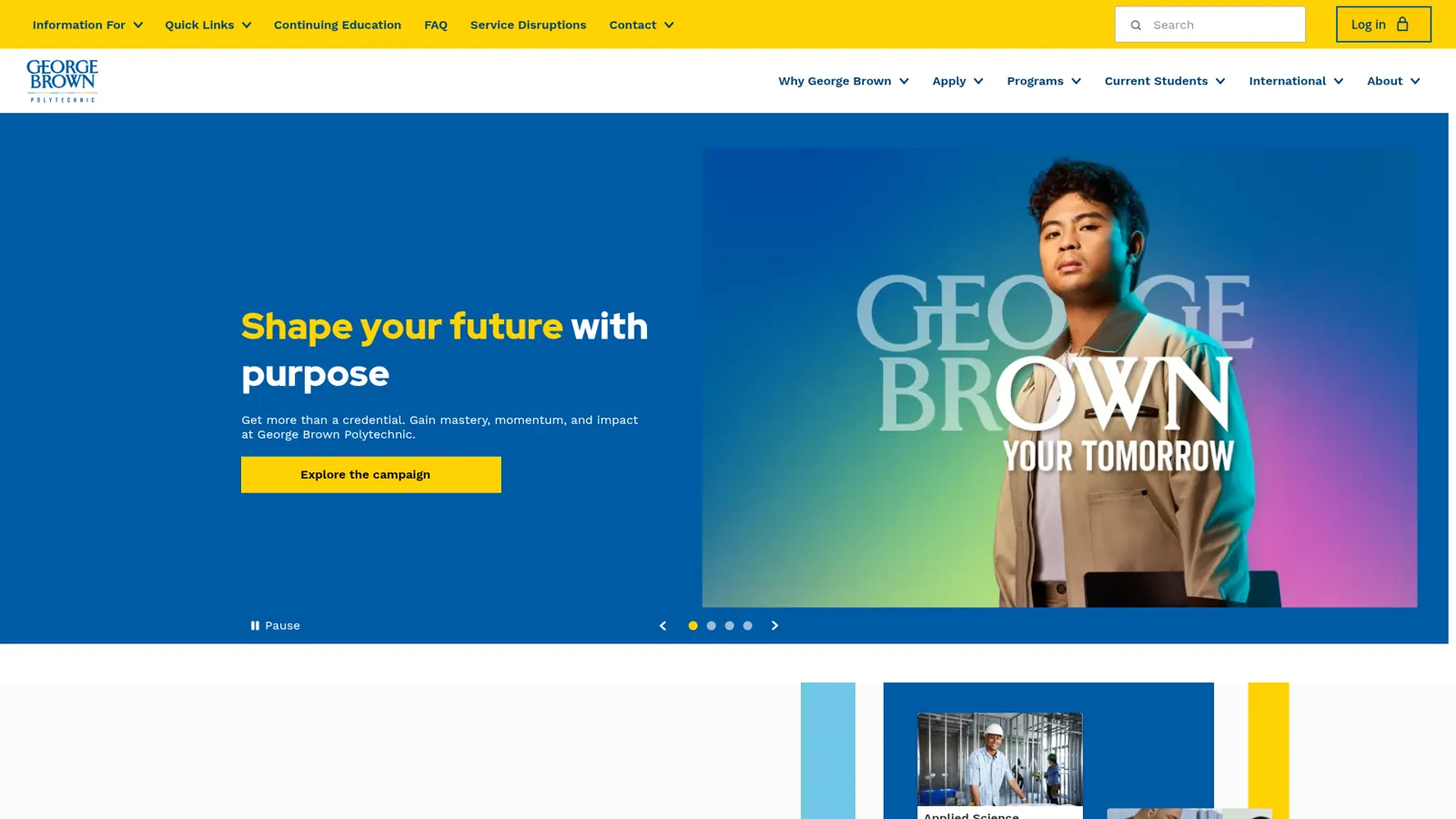
George Brown College: accessibility work
Our published case study describes accessibility audit and remediation work on a Drupal platform, alongside editor training. Review the documented scope rather than assuming the same result for another campus.
Read the case study →Separate a public portfolio claim from a reference you have actually checked.
- Ask what the agency delivered on the linked institution site, not just whether it displays a logo.
- Confirm which named people attend discovery, build, testing, and handover.
- Have IT and admissions review assumptions, exclusions, approval dependencies, and launch risks.
Sources and fact-check report
Reviewed 2026-10-05. Site sources substantiate published project scope and client recognition, not independently audited outcomes. Recommendations are editorial guidance, not revenue, ranking, compliance, price, or delivery guarantees.
- DoodleWeb Brand Book / brand guidelines
- DoodleWeb published identity and client recognition
- Published project scope: George Brown College
- W3C WCAG 2.2: Level AA conformance criteria
- Google web.dev: Core Web Vitals definitions and thresholds
- Reviewed claim: Roughly 93% of high-school students report using college websites as a primary input when deciding where to apply, and yet only about one in five higher-ed marketing leaders say their own site does that job well.
Resolution:College websites help prospective students compare programs and application requirements. Review research with your own audiences rather than relying on an unverified sector-wide percentage.
- Reviewed claim: Updated quarterly.
Resolution:Check current vendor information before procurement; this page is not an independently scored ranking.
- Reviewed claim: Section 508 compliance is required for institutions receiving federal funding.
Resolution:Confirm the institution's applicable requirements with qualified advice; federal funding alone does not establish Section 508 applicability.
- Reviewed claim: Institutions receiving federal funding are also bound by Section 508.
Resolution:Applicable legal duties depend on the institution and jurisdiction; federal funding alone does not establish Section 508 applicability.
- Reviewed claim: The studio publishes its own daily AEO/GEO citation report and applies the same discipline to client sites.
Resolution:The studio publishes AI-visibility material; ask for the scope and measurement method proposed for your engagement.
- Reviewed claim: Research and IA, custom design, Drupal/WordPress engineering, WCAG 2.2 AA, entity/schema work, ongoing improvement. $60K–$250K build, $4K–$12K/mo care.
Resolution:Request a scoped estimate covering content, templates, integrations, testing, training, and ongoing support; the price and delivery date depend on the agreed work.
- Reviewed claim: Redesigns typically start around $50K.
Resolution:Request a scoped estimate covering content, templates, integrations, testing, training, and ongoing support; the price and delivery date depend on the agreed work.
- Reviewed claim: Design engagements from around $8K.
Resolution:Request a scoped estimate covering content, templates, integrations, testing, training, and ongoing support; the price and delivery date depend on the agreed work.
- Reviewed claim: Projects commonly start around $25K.
Resolution:Request a scoped estimate covering content, templates, integrations, testing, training, and ongoing support; the price and delivery date depend on the agreed work.
- Reviewed claim: **Best for:** Mid-size universities, community colleges, and higher-ed departments (admissions, advancement, research centers, professional schools) that need a shippable site in 12–20 weeks, WCAG 2.2 AA compliance, and content that gets cited by AI answer engines — not just ranked on Google.
Resolution:**Best for:** Request a scoped estimate covering content, templates, integrations, testing, training, and ongoing support; the price and delivery date depend on the agreed work.
- Reviewed claim: - Redesign or replatform: **$60K–$250K** depending on scope, integrations, and content migration volume.
Resolution:- Request a scoped estimate covering content, templates, integrations, testing, training, and ongoing support; the price and delivery date depend on the agreed work.
- Reviewed claim: - Ongoing care: **$4K–$12K/mo** for maintenance, accessibility, small features, and reporting.
Resolution:- Request a scoped estimate covering content, templates, integrations, testing, training, and ongoing support; the price and delivery date depend on the agreed work.
- Reviewed claim: - AEO sprint (standalone): **$8K–$25K** for entity build, schema, directory submissions, and a 90-day citation baseline.
Resolution:- Request a scoped estimate covering content, templates, integrations, testing, training, and ongoing support; the price and delivery date depend on the agreed work.
- Reviewed claim: **Pricing.** Public Clutch estimates put comprehensive redesigns starting around $50K.
Resolution:**Pricing.** Request a scoped estimate covering content, templates, integrations, testing, training, and ongoing support; the price and delivery date depend on the agreed work.
- Reviewed claim: **Pricing.** Custom web design services publicly start at $8,000 per site; higher-ed engagements typically scale from there.
Resolution:**Pricing.** Request a scoped estimate covering content, templates, integrations, testing, training, and ongoing support; the price and delivery date depend on the agreed work.
- Reviewed claim: **Pricing.** Custom development engagements commonly start around $25K per project scope.
Resolution:**Pricing.** Request a scoped estimate covering content, templates, integrations, testing, training, and ongoing support; the price and delivery date depend on the agreed work.
- Reviewed claim: - Small college or department-level site: **$40K–$100K**.
Resolution:- Request a scoped estimate covering content, templates, integrations, testing, training, and ongoing support; the price and delivery date depend on the agreed work.
- Reviewed claim: - Mid-size university full redesign on Drupal or WordPress: **$100K–$300K**.
Resolution:- Request a scoped estimate covering content, templates, integrations, testing, training, and ongoing support; the price and delivery date depend on the agreed work.
- Reviewed claim: - Large university flagship redesign with heavy integrations and content strategy: **$300K–$1M+**.
Resolution:- Request a scoped estimate covering content, templates, integrations, testing, training, and ongoing support; the price and delivery date depend on the agreed work.
- Reviewed claim: Ongoing care plans typically run **$4K–$15K/month** depending on hours and integration surface area.
Resolution:Request a scoped estimate covering content, templates, integrations, testing, training, and ongoing support; the price and delivery date depend on the agreed work.
- Reviewed claim: - Departmental or program microsite: **8–14 weeks**.
Resolution:- Request a scoped estimate covering content, templates, integrations, testing, training, and ongoing support; the price and delivery date depend on the agreed work.
- Reviewed claim: - Mid-size college full redesign: **4–7 months**.
Resolution:- Request a scoped estimate covering content, templates, integrations, testing, training, and ongoing support; the price and delivery date depend on the agreed work.
- Reviewed claim: - Large-university flagship with content migration and IA overhaul: **9–18 months**.
Resolution:- Request a scoped estimate covering content, templates, integrations, testing, training, and ongoing support; the price and delivery date depend on the agreed work.
- Reviewed claim: Provider — best for — core services — typical engagement.
- **DoodleWeb** — mid-size universities, colleges, and higher-ed departments that need Drupal, WordPress, or headless React sites shipped with AEO built in so admissions content gets cited in ChatGPT and Gemini answers, not just ranked on Google. Request a scoped estimate covering content, templates, integrations, testing, training, and ongoing support; the price and delivery date depend on the agreed work.
- **Kanopi Studios** — large U.S. and Canadian universities modernizing complex Drupal and WordPress ecosystems with a continuous-improvement retainer model. Research, UX, custom design, Drupal + WordPress, accessibility, ongoing support. Custom.
- **OHO Interactive** — flagship universities and specialized arts colleges building enrollment-driven digital ecosystems anchored in prospective-student research. Discovery, brand, UX, production, launch. Custom.
- **Orbit Media** — universities where SEO visibility and conversion-rate optimization matter as much as design. Web design/development, content strategy, SEO, CRO. Request a scoped estimate covering content, templates, integrations, testing, training, and ongoing support; the price and delivery date depend on the agreed work.
- **WebFX** — large institutions bundling web design with paid media, SEO, and revenue tracking under one roof. Custom web design, SEO, revenue analytics, copywriting. Request a scoped estimate covering content, templates, integrations, testing, training, and ongoing support; the price and delivery date depend on the agreed work.
- **ERI Design** — institutions that need application development alongside the marketing site — portals, catalogs, admissions tools. Strategy, UX/UI, full-stack web and app dev, digital marketing. Custom.
- **Oomph** — universities with hard accessibility, multi-site, and compliance requirements (state systems, health science schools). Strategy, experience design and development, compliance and accessibility. Request a scoped estimate covering content, templates, integrations, testing, training, and ongoing support; the price and delivery date depend on the agreed work.
- **Eastern Standard** — large university systems and R1 research institutions taking a data-first approach to redesigns and migrations. Branding, UX research, analytics, website migrations. Custom.
- **Carnegie** — mid-size and community colleges pairing website work with enrollment marketing. Discovery, design, performance dev, ongoing support. Custom.
- **Thrive Agency** — institutions folding web design into a broader integrated-marketing engagement (SEO, content, reviews). Custom web design, SEO, content, reputation management. Custom.
Resolution:Provider — evidence to request — scope to verify — pricing.
- **DoodleWeb** — review the published George Brown College and Young Americans Center case studies; confirm accessibility, content, migration, and support responsibilities; request an itemized quote. - **Kanopi Studios** — request current higher-education references, platform demonstrations, and support terms; confirm scope directly; request a quote. - **OHO Interactive** — request audience research examples and a relevant campus reference; confirm scope directly; request a quote. - **Orbit Media** — request relevant website and measurement examples; confirm higher-education fit directly; request a quote. - **WebFX** — request campus references and separation of website and marketing deliverables; confirm scope directly; request a quote. - **ERI Design** — request application and integration examples relevant to your campus; confirm responsibilities directly; request a quote. - **Oomph** — request accessibility testing and governance evidence; confirm scope directly; request a quote. - **Eastern Standard** — request comparable migration and research examples; confirm scope directly; request a quote. - **Carnegie** — request campus website references and support details; confirm scope directly; request a quote. - **Thrive Agency** — request relevant website references and named delivery people; confirm scope directly; request a quote.
- Reviewed claim: This is a working shortlist of the agencies actually doing that work in 2026 — what each is best for, the platforms they ship on, notable clients, and honest pricing ranges.
Resolution:This is a starting list for procurement questions, not an independently verified ranking. Confirm each vendor’s current services, references, staffing, and prices directly before selection.
- Reviewed claim: WCAG 2.2 AA is the working standard, and Confirm the institution
Resolution:Use WCAG 2.2 AA as a proposed technical target. Confirm the institution
- Reviewed claim: WCAG 2.2 AA compliance, including automated axe/pa11y CI plus manual assistive-technology testing on real screen readers.
Resolution:Accessibility assessment and remediation: agree the technical target, automated checks, manual testing, and responsibility for future content in the scope.
- Reviewed claim: so admissions pages get cited in ChatGPT, Claude, Gemini, and Perplexity answers
Resolution:to improve content clarity for AI systems, without guaranteeing citations in ChatGPT, Claude, Gemini, or Perplexity answers
- Reviewed claim: Realistic ranges, based on current market data:
Resolution:Request a current proposal with separate build, migration, integration, accessibility, and support line items:
- Reviewed claim: Both are valid. Drupal remains the dominant choice for large universities and R1 research institutions because of its editorial workflows, multi-site architecture, and permission granularity.
Resolution:Both are options to assess. Demonstrate editorial workflows, multi-site needs, content relationships, and permissions in the proposed configuration rather than assuming market dominance determines fit.
- Reviewed claim: Higher-ed sites carry constraints most B2B or eCommerce sites do not: federated ownership across dozens of departments, integrations with student information systems, program-catalog structures, WCAG and Section 508 legal exposure, and a five-to-seven-year replacement cycle. Specialized agencies have templates, patterns, and past-performance references for all of those. Generalists tend to solve them for the first time on your dime.
Resolution:Higher-education projects may involve departmental publishing, program catalogs, campus-system integrations, and accessibility obligations. Ask either a specialist or generalist agency to demonstrate relevant work and explain the proposed scope. Confirm applicable legal requirements separately; sector positioning alone does not establish experience or a better project outcome.
Seattle agency · Seattle, WA
A full-service digital agency working in WordPress, Drupal, Shopify, Webflow, React, and React Native. We partner with universities, nonprofits, governments, and growing brands to ship sites that hold up after launch.