Tell us about your campus website
A senior engineer reads every message and replies within one working day.
This guide discusses several platform approaches for college websites in 2026, and the right one is determined by three variables: editor count, integration depth, and governance burden. This guide covers each platform honestly, including where it fails, plus the cost and timeline you should expect.
What are the real platform options for colleges in 2026?
WordPress, Drupal 11, Webflow, Sitecore, and headless (typically Next.js or Astro with a content API). Cascade CMS and Omni CMS are additional options to assess; do not rule them out without reviewing current features, support, integrations, and migration requirements.
When is WordPress the right choice for a college?
WordPress is worth evaluating when campus editors need familiar publishing tools and the team can maintain a supported theme and plugin stack. Prototype a real program page, approval workflow, and content export before choosing it.
Do not use enrollment size or an arbitrary editor limit as a platform rule. Confirm roles, multilingual requirements, integration support, updates, and accessibility with the implementation team. Request a scope that includes migration, redirects, testing, editor training, and support rather than treating a generic price or timeline as a quote.
When is Drupal the right choice for a college?
Evaluate Drupal when structured content, distinct editor roles, moderation, and relationships between programs and departments matter. Have the implementation team demonstrate those workflows with representative campus content.
DoodleWeb’s George Brown College case study documents accessibility work on Drupal; it does not establish a universal campus budget or integration capability. Confirm each SIS or CRM connection separately. Review our Drupal partnership and higher-ed migration approach alongside the agreed scope.
When is Webflow the right choice?
Evaluate Webflow for a design-led marketing site when the publishing workflow and content relationships fit the current product. Ask the team to demonstrate permissions, page templates, redirects, forms, and exports using your own requirements.
Do not assume a fixed page-count or enrollment cutoff. Verify how each campus integration would work, where server-side processing lives, who owns it, and how it will be supported. Include accessibility testing and content handover in the proposal; visual polish alone is not an acceptance test.
When does Sitecore or headless make sense?
Sitecore appears where an enterprise Microsoft stack and a large marketing operations team already exist. Headless makes sense when the same content must serve the website, a mobile app, and digital signage from one source. Both carry meaningfully higher year-two cost, and neither is justified by "future proofing" alone. Request a scoped estimate covering content, templates, integrations, testing, training, and ongoing support; the price and delivery date depend on the agreed work.
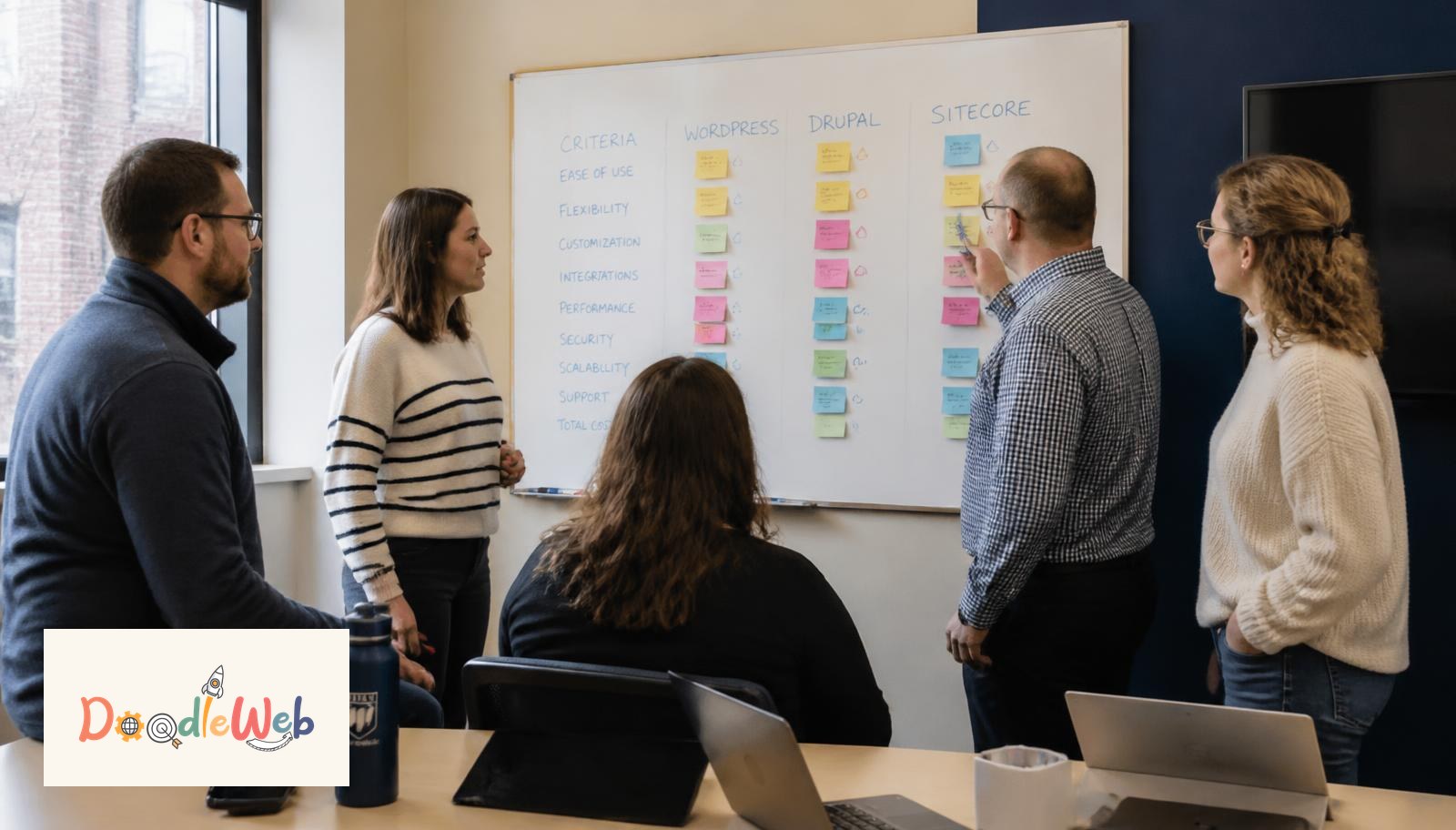
How do the platforms compare on the things that matter?
| Criterion | WordPress | Drupal 11 | Webflow |
|---|---|---|---|
| Best fit | Test editor-led publishing | Test structured campus content | Test design-led publishing |
| Editors supported | Demonstrate required roles | Demonstrate roles and moderation | Verify current workspace roles |
| SIS integration | Scope and test each connector | Scope and test each connector | Verify external integration approach |
| Governance tooling | Test the selected configuration | Test moderation and permissions | Test publishing approvals |
| Typical build cost | Request an itemized quote | Request an itemized quote | Request an itemized quote |
| Timeline | Depends on scope and approvals | Depends on migration and approvals | Depends on content and integrations |
What does accessibility require regardless of platform?
Specify accessibility acceptance criteria and testing responsibilities regardless of the CMS. WCAG 2.2 defines Level AA conformance as meeting the applicable Level A and AA success criteria. A template library alone cannot establish conformance for all published content.
Confirm applicable legal duties and current deadlines with qualified advice. Include keyboard and assistive-technology testing, media alternatives, documents, forms, and third-party tools. See our accessibility services and the published George Brown College case study for documented project scope, not a guarantee of compliance on another campus.
How should program pages be built for AI search?
Answer-first opening paragraphs stating credits, format, cost, and outcomes. Use EducationalOccupationalProgram where it fits the content and FAQPage only for visible questions and answers; markup does not guarantee a rich result or AI citation. Stable canonical URLs. Facts consistent across the site, Common App, and College Scorecard. Server-rendered HTML so assistants can read the content without executing JavaScript. Our higher education AI search visibility service covers the full program.
What is the migration plan once we choose?
Content audit and cut list, content model workshop with real editors, design system and program-page template, migration with a complete redirect map, accessibility remediation, then post-launch measurement. Skipping the audit can leave migration volume and review dependencies unclear, making the delivery plan harder to defend.
Where to go next
Read 10 questions colleges should ask about website platforms, how to choose a college website platform, and college website development in 2026. See our work with the University of Toronto and Trinity Western University, or book a free platform review.
Frequently asked questions
/What should we review before changing our campus website?
Start with the visitor task, the affected templates, accessibility barriers, publishing workflow, and integrations. Use actual visitor and editor evidence to prioritize the work rather than choosing features first.
/Do we need a full rebuild?
Not necessarily. A focused repair may address the problem if the content model and supported platform are suitable. Compare repair and rebuild scope after documenting the causes and ongoing support requirements.
/How much will the work cost?
The price depends on templates, migration, integrations, accessibility testing, training, and ongoing care. Review DoodleWeb pricing and request an itemized proposal rather than relying on a sector-wide price range.
/Can these changes guarantee more donations or applications?
No. Outcomes also depend on audience, campaign quality, program demand, and other factors. Agree on baseline measurements and review completed visitor tasks after changes.
/How can DoodleWeb help us assess the next step?
Use the contact form on this page to share the site, visitor task, and current constraints. Review the relevant published case study and ask for a scope covering assessment, implementation, testing, and handover.
Relevant client work

Berklee College of Music is a DoodleWeb client. Client recognition alone is not evidence of a particular project outcome.
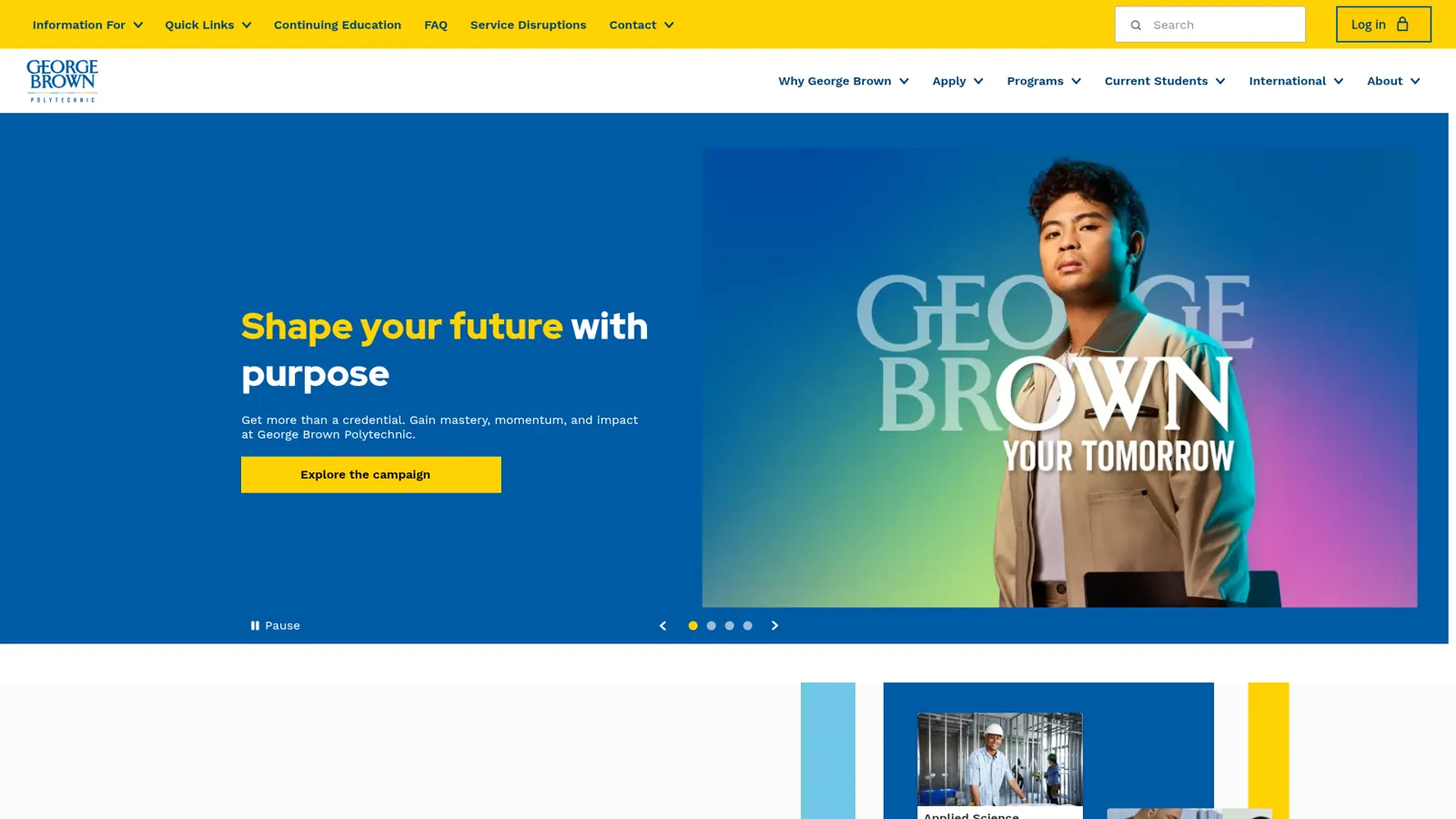
George Brown College: accessibility work
Our published case study describes accessibility audit and remediation work on a Drupal platform, alongside editor training. Review the documented scope rather than assuming the same result for another campus.
Read the case study →Prototype the hardest campus workflow before approving the CMS.
- Publish and revise one program with approval, version history, and reusable fields.
- Demonstrate searchable programs, redirects, and content exports using representative data.
- Include hosting, licenses, training, integration maintenance, and exit costs in the comparison.
Sources and fact-check report
Reviewed 2026-10-05. Site sources substantiate published project scope and client recognition, not independently audited outcomes. Recommendations are editorial guidance, not revenue, ranking, compliance, price, or delivery guarantees.
- DoodleWeb Brand Book / brand guidelines
- DoodleWeb published identity and client recognition
- Published project scope: George Brown College
- W3C WCAG 2.2: Level AA conformance criteria
- Google web.dev: Core Web Vitals definitions and thresholds
- Reviewed claim: Cascade CMS and Omni CMS still hold legacy share in higher ed, but neither is a forward-looking choice for a new build in 2026.
Resolution:Cascade CMS and Omni CMS are additional options to assess; do not rule them out without reviewing current features, support, integrations, and migration requirements.
- Reviewed claim: There are only five platforms that seriously compete for college websites in 2026
Resolution:This guide discusses several platform approaches for college websites in 2026
- Reviewed claim: Typical build: $45,000 to $95,000 over 12 to 16 weeks.
Resolution:Request a scoped estimate covering content, templates, integrations, testing, training, and ongoing support; the price and delivery date depend on the agreed work.
- Reviewed claim: Typical build: $120,000 to $340,000 over 6 to 10 months.
Resolution:Request a scoped estimate covering content, templates, integrations, testing, training, and ongoing support; the price and delivery date depend on the agreed work.
- Reviewed claim: Typical build: $35,000 to $80,000 over 8 to 14 weeks.
Resolution:Request a scoped estimate covering content, templates, integrations, testing, training, and ongoing support; the price and delivery date depend on the agreed work.
- Reviewed claim: Typical program: $500,000 to $1.4 million for large systems.
Resolution:Request a scoped estimate covering content, templates, integrations, testing, training, and ongoing support; the price and delivery date depend on the agreed work.
- Reviewed claim: | Typical build cost | $45k to $95k | $120k to $340k | $35k to $80k |
Resolution:| Typical build cost | Quoted for the agreed scope | Quoted for the agreed scope | Quoted for the agreed scope |
- Reviewed claim: Under roughly 3,000 FTE, marketing-led teams, fewer than 25 editors, and no live SIS integration. WordPress with a locked block library and Advanced Custom Fields gives a small team the fastest publishing workflow available. Where it fails: complex editorial workflow, multilingual at scale, and sites where twenty departments each need different permissions. Request a scoped estimate covering content, templates, integrations, testing, training, and ongoing support; the price and delivery date depend on the agreed work.
Resolution:WordPress is worth evaluating when campus editors need familiar publishing tools and the team can maintain a supported theme and plugin stack. Prototype a real program page, approval workflow, and content export before choosing it.
Do not use enrollment size or an arbitrary editor limit as a platform rule. Confirm roles, multilingual requirements, integration support, updates, and accessibility with the implementation team. Request a scope that includes migration, redirects, testing, editor training, and support rather than treating a generic price or timeline as a quote.
- Reviewed claim: Public colleges, mid-to-large private institutions, strict governance, multilingual requirements, and deep Banner, Colleague, or Slate integration. Drupal 11's workspaces, content moderation, and granular permissions are still the strongest governance tooling in the category. Where it fails: small teams without developer support find it heavy. Request a scoped estimate covering content, templates, integrations, testing, training, and ongoing support; the price and delivery date depend on the agreed work. We are a [certified Drupal partner](/drupal-certified-partner) and run [higher-ed Drupal migrations](/services/drupal-higher-education-migration).
Resolution:Evaluate Drupal when structured content, distinct editor roles, moderation, and relationships between programs and departments matter. Have the implementation team demonstrate those workflows with representative campus content.
DoodleWeb’s George Brown College case study documents accessibility work on Drupal; it does not establish a universal campus budget or integration capability. Confirm each SIS or CRM connection separately. Review our Drupal partnership and higher-ed migration approach alongside the agreed scope.
- Reviewed claim: Small liberal arts colleges under 3,000 FTE with a designer-led team, fewer than 150 pages, and no integration requirements. It produces the best design output per dollar of any option here. Where it fails: editor permissions, large content models, and anything requiring server-side logic. Request a scoped estimate covering content, templates, integrations, testing, training, and ongoing support; the price and delivery date depend on the agreed work.
Resolution:Evaluate Webflow for a design-led marketing site when the publishing workflow and content relationships fit the current product. Ask the team to demonstrate permissions, page templates, redirects, forms, and exports using your own requirements.
Do not assume a fixed page-count or enrollment cutoff. Verify how each campus integration would work, where server-side processing lives, who owns it, and how it will be supported. Include accessibility testing and content handover in the proposal; visual polish alone is not an acceptance test.
- Reviewed claim: | Criterion | WordPress | Drupal 11 | Webflow |
| --- | --- | --- | --- |
| Best fit | Under 3,000 FTE | Public and large private | Small liberal arts |
| Editors supported | Up to ~25 | 50 to 500 | Up to ~10 |
| SIS integration | Limited | Strong | None |
| Governance tooling | Basic | Strongest | Minimal |
| Typical build cost | Quoted for the agreed scope | Quoted for the agreed scope | Quoted for the agreed scope |
| Timeline | 12 to 16 weeks | 6 to 10 months | 8 to 14 weeks |
Resolution:| Criterion | WordPress | Drupal 11 | Webflow | | --- | --- | --- | --- | | Best fit | Test editor-led publishing | Test structured campus content | Test design-led publishing | | Editors supported | Demonstrate required roles | Demonstrate roles and moderation | Verify current workspace roles | | SIS integration | Scope and test each connector | Scope and test each connector | Verify external integration approach | | Governance tooling | Test the selected configuration | Test moderation and permissions | Test publishing approvals | | Typical build cost | Request an itemized quote | Request an itemized quote | Request an itemized quote | | Timeline | Depends on scope and approvals | Depends on migration and approvals | Depends on content and integrations |
- Reviewed claim: WCAG 2.2 AA. Public colleges face DOJ Title II compliance dates of April 24, 2026 or April 26, 2027 depending on population served, and private nonprofits are covered under Section 504 and ADA Title III. No platform is accessible by default. Templates, media, and PDFs all need work, and testing belongs in CI. See our [accessibility services](/accessibility) and the remediation programs we ran for [George Brown College](/case-study/george-brown-college) and [Trinity Western University](/case-study/trinity-western-university).
Resolution:Specify accessibility acceptance criteria and testing responsibilities regardless of the CMS. WCAG 2.2 defines Level AA conformance as meeting the applicable Level A and AA success criteria. A template library alone cannot establish conformance for all published content.
Confirm applicable legal duties and current deadlines with qualified advice. Include keyboard and assistive-technology testing, media alternatives, documents, forms, and third-party tools. See our accessibility services and the published George Brown College case study for documented project scope, not a guarantee of compliance on another campus.
- Reviewed claim: EducationalOccupationalProgram and FAQPage JSON-LD on every program.
Resolution:Use EducationalOccupationalProgram where it fits the content and FAQPage only for visible questions and answers; markup does not guarantee a rich result or AI citation.
- Reviewed claim: Skipping the audit is the mistake that turns a four-month project into a fourteen-month one.
Resolution:Skipping the audit can leave migration volume and review dependencies unclear, making the delivery plan harder to defend.
Seattle agency · Seattle, WA
A full-service digital agency working in WordPress, Drupal, Shopify, Webflow, React, and React Native. We partner with universities, nonprofits, governments, and growing brands to ship sites that hold up after launch.